

Chicken Road Strategies for New Zealand Players
A practical framework for consistent session behaviour: entry sizing, exit structure, and risk limits in NZ$.
Starter strategies for new Kiwi players
Start with repeatable routines, not high-risk targets. A stable early structure is fixed stake sizing, fixed exit band, and strict session timer.
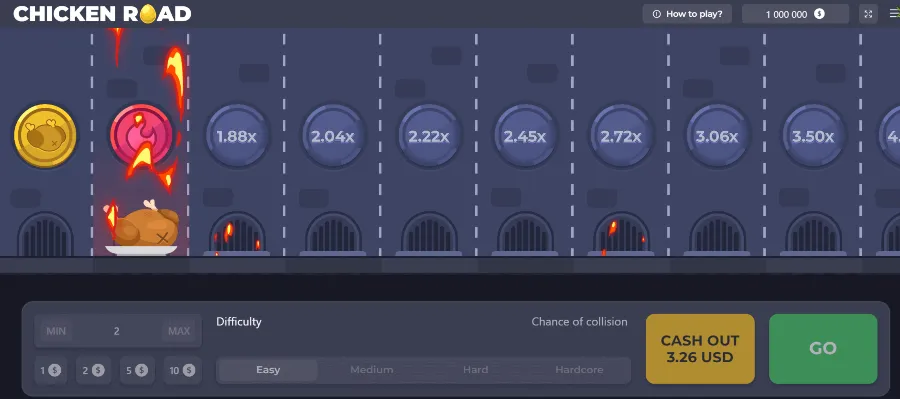
- Conservative line: x1.8 exits, high hit frequency.
- Balanced line: x2.0-x2.2, moderate volatility.
- Aggressive line: x3.0+, lower hit rate and larger drawdown.
Bankroll management is the real edge
Use fixed percentage exposure per round. For most NZ players, 1%-3% of active session bankroll is safer than flat emotional sizing.
| Session bankroll | Low risk stake (1%) | Moderate stake (2%) | High stake (3%) |
|---|---|---|---|
| NZ$100 | NZ$1 | NZ$2 | NZ$3 |
| NZ$250 | NZ$2.50 | NZ$5 | NZ$7.50 |
| NZ$500 | NZ$5 | NZ$10 | NZ$15 |
Define stop-loss and stop-win before the first round. If either level is hit, end session immediately.





Progressive auto cashout structure
Auto cashout helps remove impulsive overrides. A practical NZ routine:
- Phase 1: x1.8 until small cushion built.
- Phase 2: x2.1 with unchanged stake size.
- Phase 3: optional short high-target burst using profit only.
Never increase stake size because of a short losing streak. If behaviour slips, reset to phase 1.
Advanced session control for experienced players
Advanced play is mostly process control: prewritten plans, time blocks, and post-session review. Keep a short log of outcomes and decisions, not just profit/loss.
- Plan each session in 3 blocks (warm-up, execution, close-out).
- Reduce stakes if decision quality drops.
- Do not chase losses with oversized entries.
Common mistakes and how to avoid them
- Changing strategy mid-session after two losses.
- Raising stake to recover quickly.
- Ignoring pre-set stop-loss.
- Playing tired or emotionally tilted.
Correction is simple: hard limits, fixed rules, and forced session breaks.
Strategy comparison table
| Approach | Risk | Win-rate tendency | Best for |
|---|---|---|---|
| Conservative x1.8 | Low | Higher | Bankroll protection |
| Balanced x2.0-x2.2 | Medium | Medium | Regular sessions |
| Aggressive x3+ | High | Lower | Experienced players only |
Detailed strategy frameworks with NZ$ examples
Each framework below is designed as a complete session structure, not a single-round trick. The difference matters: a strategy is a repeatable process across 30–50 rounds, not a bet size for the next spin. Choose one framework, commit to it for a full session, and evaluate performance only after completing the block.
Conservative framework: "The Kiwi Shield"
Built for bankroll preservation with minimal drawdown. Ideal for players who want extended session time and can accept modest per-round returns in exchange for durability.
| Parameter | Setting | NZ$ example (NZ$100 bankroll) |
|---|---|---|
| Stake per round | 1% of session bankroll | NZ$1.00 |
| Exit target | x1.5 auto cashout | NZ$1.50 return per hit |
| Stop-loss | 15% of bankroll | NZ$15 |
| Stop-win | 20% of bankroll | NZ$20 profit |
| Session rounds | 40–60 | ~40 minutes at moderate pace |
| Expected hit rate | ~65% | 26 of 40 rounds |
Over 40 rounds at NZ$1 stakes with x1.5 exits and a ~65% hit rate: expected gross return ≈ NZ$39 (26 hits × NZ$1.50), expected cost ≈ NZ$40 wagered, theoretical net ≈ -NZ$0.80 (2% house edge). In practice, variance creates swings of ±NZ$15 around this baseline. The conservative framework absorbs those swings without triggering stop-loss in most sessions.
Moderate framework: "The Wellington Line"
Balanced between durability and return potential. This is the framework most NZ players gravitate toward after their first week of live play.
| Parameter | Setting | NZ$ example (NZ$200 bankroll) |
|---|---|---|
| Stake per round | 1.5% of session bankroll | NZ$3.00 |
| Exit target | x2.0 auto cashout | NZ$6.00 return per hit |
| Stop-loss | 20% of bankroll | NZ$40 |
| Stop-win | 25% of bankroll | NZ$50 profit |
| Session rounds | 30–50 | ~30 minutes |
| Expected hit rate | ~49% | 15 of 30 rounds |
This framework balances return per hit against loss frequency. At x2.0 exits, roughly half your rounds hit and half miss, creating a jagged equity curve that requires emotional tolerance. The NZ$40 stop-loss provides enough runway for a 10-round losing streak (NZ$30 cost) while keeping a buffer before forced exit.
Aggressive framework: "The Auckland Burst"
Short, high-target sessions designed for experienced players who accept higher loss probability in exchange for larger individual wins. Not recommended for first-month players.
| Parameter | Setting | NZ$ example (NZ$300 bankroll) |
|---|---|---|
| Stake per round | 2% of session bankroll | NZ$6.00 |
| Exit target | x3.5 auto cashout | NZ$21.00 return per hit |
| Stop-loss | 25% of bankroll | NZ$75 |
| Stop-win | 40% of bankroll | NZ$120 profit |
| Session rounds | 15–25 | ~15 minutes |
| Expected hit rate | ~28% | 4–7 of 25 rounds |
At x3.5, you will lose approximately 7 of every 10 rounds. A streak of 12–15 consecutive losses is statistically expected within any 100-round sample. If that prospect causes anxiety, this framework is too aggressive for your current tolerance level. Scale down to The Wellington Line until your tracked sessions show consistent zero-override discipline at x2.0.
Why Martingale fails and what to use instead
Martingale — doubling your stake after every loss — is the most commonly suggested crash game strategy and the fastest route to total bankroll destruction. Here is why it fails mathematically in the NZ$ context:
| Round | Stake (Martingale) | Cumulative risk | Win at x2.0 | Net if hit |
|---|---|---|---|---|
| 1 | NZ$2 | NZ$2 | NZ$4 | +NZ$2 |
| 2 (loss) | NZ$4 | NZ$6 | NZ$8 | +NZ$2 |
| 3 (loss) | NZ$8 | NZ$14 | NZ$16 | +NZ$2 |
| 4 (loss) | NZ$16 | NZ$30 | NZ$32 | +NZ$2 |
| 5 (loss) | NZ$32 | NZ$62 | NZ$64 | +NZ$2 |
| 6 (loss) | NZ$64 | NZ$126 | NZ$128 | +NZ$2 |
| 7 (loss) | NZ$128 | NZ$254 | — | Bankroll gone |
After just seven consecutive losses — an event with roughly 0.8% probability per seven-round block — a NZ$2 starting stake has consumed NZ$254 of bankroll for a maximum possible gain of NZ$2. The risk-to-reward ratio is catastrophic. Over 500 rounds, encountering at least one seven-loss streak is virtually guaranteed.
Anti-Martingale (reverse) approach
Instead of increasing stakes after losses, increase them modestly after wins — using profit as the increased exposure. This caps downside to your original stake while allowing winning streaks to compound slightly.
| Condition | Stake adjustment | NZ$ example |
|---|---|---|
| After a win | Increase by 50% of profit, max 2 rounds | Win NZ$4 → next stake NZ$3 (NZ$2 base + NZ$1 from profit) |
| After a loss | Return immediately to base stake | Back to NZ$2 |
| After 2 consecutive wins | Lock profit, return to base | Bank the NZ$3 gain, restart at NZ$2 |
This approach will not overcome the house edge — nothing will — but it prevents the exponential ruin curve of Martingale while allowing occasional streak-based upside. Connor from Palmerston North reports using Anti-Martingale across 200 rounds with NZ$150 starting bankroll and finishing at NZ$138 — a NZ$12 cost that aligned closely with the 2% theoretical edge on his total turnover.
Session planning protocol for NZ players
A session plan is not optional — it is the structural difference between gambling and structured play. Every serious Kiwi Chicken Road player should complete this checklist before opening the game:
Pre-session checklist (5 minutes)
- Check your emotional state: Tired? Stressed? Had a few drinks? If yes to any, skip this session. Decision quality drops measurably when you are not at baseline.
- Set financial parameters: Session bankroll, stake per round, exit target, stop-loss, stop-win. Write them down. If writing them feels tedious, that is the point — it makes the commitment real.
- Set time limit: 20–40 minutes for standard sessions. Set a physical timer on your phone. When it sounds, the session ends regardless of your balance position.
- Check platform limits: Verify deposit and loss limits are active on your operator account. These are your safety net when discipline fails.
- Review last session log: What went well? What went wrong? Did you override any rules? If the last session had three or more overrides, reduce today's stake by 50% as a discipline calibration.
During-session protocol
- Follow your plan. Do not adjust exit targets, stake sizes, or time limits mid-session.
- If you feel the urge to change something, note the round number and the impulse. Resist it. Analyse it post-session.
- If stop-loss or stop-win is triggered, close the game immediately. Not "after this round" — now.
- If your timer sounds mid-round, complete the current round and exit. Do not start a new round.
Post-session review (5 minutes)
- Record: rounds played, final balance, plan overrides, emotional state, and end reason (stop-loss/stop-win/timer/voluntary).
- Calculate actual return percentage: (total returned / total wagered) × 100. Compare to 98% over time.
- Rate your discipline: 1–5 scale. Below 3 means mandatory stake reduction next session.
Aroha from Napier has tracked 40 sessions using this protocol. Her average session cost is NZ$4.20 — closely aligned with the 2% theoretical edge on her average NZ$210 total turnover per session. More importantly, her plan-override count dropped from six per session in week one to below one per session by week four.
Psychological discipline: the real strategy edge
Every framework on this page is worthless without execution discipline. Strategy documents are written in calm environments; they must survive emotional environments. Here is how NZ players build the mental infrastructure to actually follow through.
Identity-based commitment
Instead of "I will try to stick to x2.0 exits", reframe as "I am the kind of player who follows the plan regardless of short-term results." This shift — from intention to identity — creates stronger resistance to mid-session overrides because breaking the plan feels like a personal contradiction rather than a minor adjustment.
Decision fatigue management
Every manual decision during a session consumes cognitive resources. After 20–30 manual cashout decisions, your ability to stick to the plan degrades. This is why auto cashout exists — it removes the per-round decision entirely, preserving your cognitive capacity for the meta-decisions (continue playing or stop, maintain stake or adjust next session).
A practical test: play 30 rounds with manual cashout, then 30 rounds with auto cashout at the same target. Compare your plan-override count and emotional state between the two blocks. Most NZ players who run this test report that auto cashout sessions feel quieter, produce fewer errors, and end with better post-session energy. The per-round excitement is lower, but the per-session quality is higher.
Variance tolerance calibration
Your stake size should be set so that a 10-round losing streak costs no more than 20% of your session bankroll. For a NZ$100 session at x2.0 exits, that means NZ$2 per round (10 × NZ$2 = NZ$20 = 20%). If a 10-round loss at your current stake would make you anxious, your stake is too high. Scale down until the worst realistic streak feels manageable.
| Session bankroll | 10-loss tolerance (20%) | Max stake per round | Rounds before stop-loss |
|---|---|---|---|
| NZ$50 | NZ$10 | NZ$1.00 | 10 |
| NZ$100 | NZ$20 | NZ$2.00 | 10 |
| NZ$200 | NZ$40 | NZ$4.00 | 10 |
| NZ$500 | NZ$100 | NZ$10.00 | 10 |
This table is not aspirational — it is a hard constraint. If your bankroll is NZ$100 and you are betting NZ$5 per round, you are operating at 2.5× the recommended exposure level. Two bad streaks will blow your stop-loss and leave you with zero decision-quality capital for the rest of the week.
The cool-down protocol
After any session that ends on stop-loss, enforce a minimum 24-hour gap before the next live session. You can review data, adjust your plan, or run demo rounds during this period. What you cannot do is deposit more NZ$ and try again the same day. This rule exists because the strongest emotional driver in crash games is the desire to recover recent losses — and that desire leads to the worst decisions.
Isla from Hamilton reports that implementing the 24-hour cool-down after stop-loss sessions reduced her monthly total losses by roughly 35% compared to the previous month where she would often play two or three sessions on a bad day. The second and third sessions were almost always worse than the first because accumulated emotional damage compounded decision errors.
How RTP shapes your strategy choices
Chicken Road's 98% RTP creates a specific strategic context that differs from lower-RTP games. Understanding this context helps you make sharper framework selections.
At 98% RTP, the house edge is NZ$2 per NZ$100 wagered. Over a 40-round session at NZ$2 stakes (NZ$80 total wagered), the expected cost is approximately NZ$1.60. This is remarkably low compared to traditional NZ pokies at 92–95% RTP, where the same session would cost NZ$4.00–NZ$6.40 in theoretical edge.
The practical implication: at 98% RTP, your strategy does not need to "beat the game" — it needs to keep you in the game long enough for the low house edge to show its advantage. Strategies that prioritise session survival (conservative and moderate frameworks) are mathematically better suited to high-RTP environments because they maximise the number of rounds you play at favourable conditions.
Aggressive strategies with high exit targets effectively trade the RTP advantage for variance exposure. At x3.5 exits, you are playing fewer rounds with larger individual swings, which means the 98% RTP has less statistical room to converge to the mean. You are choosing excitement over efficiency — a valid personal preference but not a mathematical improvement.
| Framework | Avg rounds per session | Total wagered (NZ$2 stake) | Expected cost (2% edge) | Variance impact |
|---|---|---|---|---|
| Conservative (x1.5) | 50 | NZ$100 | NZ$2.00 | Low — frequent small outcomes |
| Moderate (x2.0) | 35 | NZ$70 | NZ$1.40 | Medium — balanced swings |
| Aggressive (x3.5) | 20 | NZ$40 | NZ$0.80 | High — large per-session swings |
The cost column looks lowest for aggressive play, but that is misleading — the fewer rounds mean wider outcome distribution. A conservative player ending a session within ±NZ$15 of starting balance is normal. An aggressive player ending within ±NZ$60 is equally normal for the same total wagered. The question is which distribution you can tolerate without breaking your plan.
How NZ players approach strategy differently
Feedback from Kiwi Chicken Road players reveals a community that skews toward disciplined, conservative play — a trend worth understanding whether you personally follow it or not.
Session brevity: The average NZ player session runs 20–30 minutes, shorter than the 40–60 minute sessions reported by European players. This correlates with fewer plan overrides and better post-session discipline scores. The shorter session window appears to be a cultural norm rather than a deliberate strategy choice, but it produces measurably better process outcomes.
Stop-loss compliance: NZ players report higher stop-loss adherence than average. In community surveys, approximately 70% of Kiwi respondents say they close the game within two rounds of hitting their stop-loss, compared to roughly 50% in broader crash game communities. The stronger compliance likely reflects NZ's higher baseline awareness of gambling harm — pokies-related harm receives significant media coverage in New Zealand, and that awareness transfers to online formats.
Bankroll conservatism: The typical NZ Chicken Road player starts with a session bankroll of NZ$50–NZ$150, smaller than the equivalent in EUR or GBP markets. This natural conservatism forces smaller stake sizes that align well with the 1–2% exposure recommendation. A NZ$100 session bankroll at 1% exposure means NZ$1 per round — a stake level where a 10-round losing streak costs NZ$10 instead of NZ$50, making it psychologically manageable.
Demo-to-live ratio: NZ players spend more rounds in demo before transitioning to live play than most markets. The median reported demo volume is approximately 150 rounds before first live session, versus 50–80 in other English-speaking markets. This extended preparation period correlates with smoother first-week live sessions and fewer early-stage bankroll blowouts.
None of these trends guarantee individual success — variance does not care about cultural tendencies. But they describe an environment where the community norm supports disciplined play, which makes it easier for individual players to maintain their own standards. If everyone around you is discussing stop-loss protocols, you are less likely to dismiss them as unnecessary.
FAQ - Chicken Road Strategies NZ
Most asked questions from Kiwi readers.
Fixed low stakes with x1.8-x2.0 exits and strict stop-loss controls.
No. Escalating stakes after losses increases ruin risk quickly in high-variance flows.
20-40 minutes is a practical window for most players before decision quality drops.
Gambling Helpline NZ: 0800 654 655 and gamblinghelpline.co.nz.
NZ player strategy experiences
First-hand feedback from Kiwi players who applied structured session management to Chicken Road.
"The conservative x1.8 line felt boring at first, but after 200 rounds my bankroll was still intact while a mate who chased x5+ was down NZ$120. I track every session in a notebook and the discipline keeps me honest. The strategy is not about excitement — it is about survival."
"I tried the progressive auto cashout method: x1.8 first, then x2.1, then a short x3.0 burst with profit only. It works if you genuinely stick to the phases. My mistake was jumping to phase 3 too early twice, which cost me the cushion I had built. Reset to phase 1, rebuilt, and now I follow the sequence properly."
"The biggest lesson: no strategy protects you from yourself. I had a solid plan — 1% stake sizing, x2.0 exits, NZ$30 stop-loss. But after a bad streak I doubled my stake anyway. Lost NZ$60 in ten minutes. The framework was fine. I was the weak link. Now I set hard platform limits that I cannot override mid-session."
Session logging template for NZ players
A session log turns abstract strategy into accountable data. Copy this format before every session and fill it in as you play. After ten logged sessions, patterns in your behaviour become unmistakable.
| Field | Pre-session entry | Post-session entry |
|---|---|---|
| Date and start time | 31 Mar 2026, 7:15 PM NZST | — |
| Session bankroll | NZ$100 | — |
| Stake per round | NZ$2 (2%) | — |
| Exit target | x2.0 auto cashout | — |
| Stop-loss | NZ$30 | — |
| Stop-win | NZ$40 profit | — |
| Time limit | 30 minutes | — |
| Rounds played | — | 38 |
| Plan overrides | — | 2 (raised exit to x2.5 twice) |
| Final balance | — | NZ$112 (+NZ$12) |
| End reason | — | Hit time limit |
| Emotional state | — | Calm first 20 min, impatient last 10 |
The most valuable row is "Plan overrides". If that number exceeds three in a single session, your execution quality is degraded regardless of the financial outcome. A profitable session with five overrides is worse preparation than a break-even session with zero overrides, because the next hundred rounds will revert to the mean and inconsistency will cost you.
Emotional control framework for Kiwi players
Strategy documents read well on a screen. Executing them under pressure is a different matter entirely. Emotional control is the gap between knowing what to do and actually doing it when NZ$ is at stake and the last three rounds all ended in losses.
Three practical tools that NZ players report as genuinely useful:
- Pre-commitment statement: Before opening the game, write one sentence describing exactly what you will do and when you will stop. Keep it visible during play. Example: "NZ$2 stakes, x2.0 exits, stop at NZ$30 loss or NZ$40 win or 30 minutes, whichever comes first."
- Physical timer: Set a phone alarm for your session limit. When it sounds, close the game immediately — no negotiation, no "finish this block". The alarm is a hard boundary, not a suggestion.
- Cool-down rule: After any session that ends on a losing streak, enforce a minimum 4-hour gap before the next session. This prevents revenge-play, which is the most expensive emotional pattern in crash games.
Emotional control is not about suppressing feelings. It is about creating external constraints that hold even when internal discipline fails. Platform-level deposit and loss limits serve this purpose directly — set them before your first session and review them monthly.
If you find that emotional overrides are repeatedly breaking your strategy, consider whether your stake size is too high for comfort. Reducing stake from 2% to 1% of session bankroll often restores control because each individual loss carries less psychological weight. The goal is sessions where following your plan feels achievable, not heroic.
One framework that NZ players find particularly effective is the "three-strike" rule: if you override your strategy three times in a single session — regardless of whether the overrides were profitable — close the game immediately and record the session as a discipline failure, not a financial event. Over time, your strike count drops as the habit of following the plan becomes automatic. Players who track this report reaching near-zero override sessions within two to three weeks of consistent application.
Continue your NZ strategy stack