

Chicken Road RTP in NZ: What the Numbers Actually Mean
A practical breakdown of RTP, house edge, volatility, and why short-term results can feel chaotic even in a fair model.
What RTP is and what it is not
RTP is a long-run return model, not a short-run promise. At 98%, the theoretical edge retained by the house is 2% over very large sample sizes.
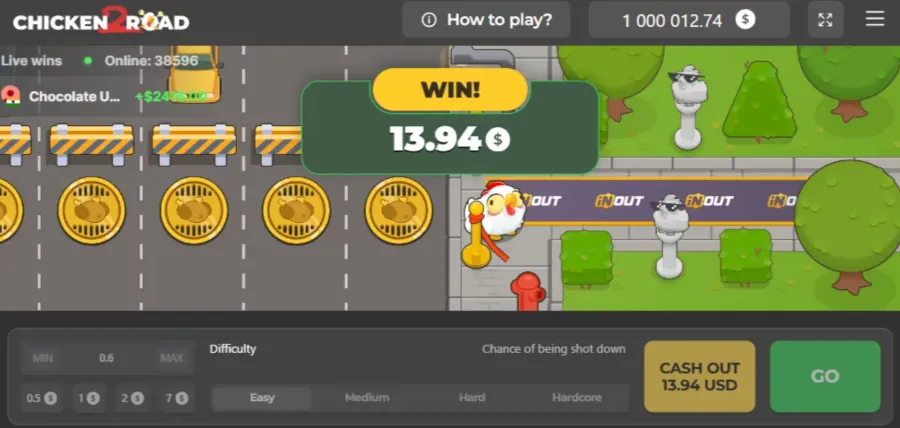
In short sessions, outcomes can deviate sharply. That is normal variance, not automatic evidence of manipulation.
What 98% means in practical NZ$ terms
If total turnover is NZ$1,000, expected model cost is around NZ$20 over long samples. In a short block of rounds, you can still be far above or below this.
| Total turnover | Theoretical cost (2%) | Comment |
|---|---|---|
| NZ$500 | NZ$10 | Small session benchmark |
| NZ$1,000 | NZ$20 | Useful weekly reference |
| NZ$5,000 | NZ$100 | Longer-term projection |





Variance and multiplier behaviour
Chicken Road has medium-high variance: frequent low-to-mid multipliers, with occasional high spikes. This creates jagged equity curves and emotionally difficult stretches.
- Low exits (x1.5-x2.0) improve hit frequency.
- High targets increase reward potential but lengthen losing runs.
- Bankroll stability usually improves with smaller, consistent stakes.
How it compares to other game types
| Game category | Typical RTP range | Takeaway |
|---|---|---|
| Crash games | ~96%-98% | Chicken Road sits near upper end |
| Slots | ~92%-96% | Often wider spread by title |
| Table games | Varies by rules | Skill/rule context matters |
RTP alone does not define experience. Volatility and decision quality matter just as much.
Fairness checks and trust signals
Use only licensed operators and verify account, terms, and support transparency. For NZ readers, keep a clear distinction between informational content and direct operator claims.
- Read contribution and wagering terms before deposit.
- Avoid any source promising guaranteed outcomes.
- Keep session records if you review performance seriously.
Session maths for realistic NZ$ planning
A practical setup for newer players is small stake sizing plus strict stop-loss and time caps. This protects decision quality and reduces emotional overreach.
RTP mathematics explained from first principles
Return to Player is a statistical projection, not a guarantee. Understanding the maths behind the 98% figure helps NZ players make sharper bankroll decisions and resist the common misinterpretation that "98% means I should break even."
The formula
RTP = (Total returned to all players / Total wagered by all players) × 100, measured across millions of rounds. For Chicken Road at 98%, the game is designed so that for every NZ$1,000,000 wagered collectively by all players worldwide, approximately NZ$980,000 is returned through cashouts. The remaining NZ$20,000 is the house edge — the operator's gross revenue from the game.
Why your individual sessions deviate
RTP is a population-level metric. Your personal return across 50 rounds is governed by variance, not the long-run average. Think of it this way: if 10,000 NZ players each play 50 rounds, the average return across all 500,000 rounds will be close to 98%. But individual players within that group will have returns ranging from 0% (lost everything) to 300%+ (hit a lucky streak). Both outcomes are consistent with a 98% RTP game.
The standard deviation narrows as sample size increases. At 50 rounds, your personal result could easily be ±40% from the mean. At 5,000 rounds, the range tightens to approximately ±5%. This is why long-term disciplined play converges toward the theoretical figure while any single session feels like chaos.
House edge in NZ$ context
The 2% house edge means that for every NZ$1 wagered, the expected operator take is NZ$0.02. Over a session of 40 rounds at NZ$2 stakes (NZ$80 total wagered), the expected cost is NZ$1.60. Over a month of 20 such sessions (NZ$1,600 total wagered), the expected cost is NZ$32. These figures set the baseline for how much Chicken Road "costs" to play at a given volume — everything above or below this line is variance.
| Monthly play volume | Total wagered | Expected cost (2%) | Weekly equivalent |
|---|---|---|---|
| Light (10 sessions) | NZ$800 | NZ$16 | NZ$4/week |
| Regular (20 sessions) | NZ$1,600 | NZ$32 | NZ$8/week |
| Heavy (40 sessions) | NZ$3,200 | NZ$64 | NZ$16/week |
For most Kiwi recreational players, the NZ$8/week expected cost of regular play is comparable to a streaming subscription or two coffees. The danger is not the house edge — it is the variance that can deliver NZ$100 swings within a week despite the low theoretical cost. Managing that variance through stop-loss limits is the practical application of understanding RTP maths.
Crash games RTP comparison table
Chicken Road's 98% RTP positions it among the most player-friendly options in the crash game category. Here is how it compares to other crash and fast-paced games accessible to NZ players:
| Game | Provider | RTP | House edge | Max multiplier | Variance rating |
|---|---|---|---|---|---|
| Chicken Road | Turbo Games | 98% | 2% | x150 | Medium-High |
| Aviator | Spribe | 97% | 3% | No fixed cap | High |
| JetX | SmartSoft | 97% | 3% | x25,000 | Very High |
| Crash (generic) | Various | 95–97% | 3–5% | Varies | High |
| Plinko (crypto) | Various | 96–99% | 1–4% | Varies | Varies |
| Mines | Various | 96–98% | 2–4% | Player-chosen | Adjustable |
| Standard NZ pokies | Various | 92–96% | 4–8% | Varies | Wide range |
The 1% RTP gap between Chicken Road (98%) and Aviator (97%) may seem minor, but it compounds: over NZ$10,000 total wagered, Chicken Road costs NZ$200 in theoretical edge versus NZ$300 for Aviator. That NZ$100 difference is bankroll that stays in your account.
Chicken Road's x150 max multiplier is lower than some competitors (Aviator has no fixed cap, JetX reaches x25,000), but the capped upside contributes to the higher RTP. Games with uncapped multipliers typically fund the rare extreme outcomes by taking a larger slice from all rounds. The trade-off: Chicken Road offers better sustainability; uncapped games offer better lottery-style potential.
Variance deep dive: why sessions feel unpredictable
Variance is the statistical term for the gap between what "should" happen (the 98% average) and what actually happens in any finite sample. High variance means wider swings; low variance means tighter clustering around the mean. Chicken Road sits at medium-high variance — enough to deliver exciting sessions but also enough to create genuinely stressful losing streaks.
How variance works in crash games
In each round, you either hit your exit target (win) or miss (lose everything wagered). At x2.0 exits, approximately 49% of rounds hit and 51% miss. This near-coin-flip dynamic creates maximum short-term uncertainty — you cannot predict the next round's outcome, and sequences of 5–10 consecutive losses are mathematically ordinary.
The variance effect amplifies with exit target. At x1.5, approximately 65% of rounds hit — you lose less often but win less per round. At x5.0, approximately 19% hit — you win big but lose four out of five rounds. Higher exit targets increase variance regardless of the underlying RTP.
Session variance in NZ$ terms
| Exit target | Hit probability | Expected profit per NZ$2 wagered | Std deviation per round | 50-round session swing range |
|---|---|---|---|---|
| x1.5 | 65% | -NZ$0.05 | NZ$1.43 | ±NZ$10 |
| x2.0 | 49% | -NZ$0.04 | NZ$2.00 | ±NZ$14 |
| x3.0 | 32% | -NZ$0.08 | NZ$3.06 | ±NZ$22 |
| x5.0 | 19% | -NZ$0.10 | NZ$4.12 | ±NZ$29 |
The "50-round session swing range" column shows the approximate band within which most session outcomes fall (roughly one standard deviation from the mean in each direction). A player using x2.0 exits will finish most sessions between NZ$14 up and NZ$14 down from their starting balance. But "most" means approximately 68% — the other 32% of sessions will fall outside this range, including occasional sessions that exceed ±NZ$30.
Variance is not rigging
The hardest concept for new players: variance streaks that feel unfair are actually evidence the game is operating correctly. A perfectly fair coin lands on the same side five or more times in a row roughly once in every 16 sequences. Chicken Road's near-50/50 outcomes at x2.0 follow the same logic. If you never experienced a losing streak, the game would be suspicious — not fair.
Session simulations with NZ$ bankrolls
Simulations help bridge the gap between theoretical RTP and lived experience. Below are three scenario simulations for a NZ player with a NZ$100 starting session bankroll, NZ$2 stakes, and different exit targets over 50 rounds:
Simulation 1: Conservative (x1.5, auto cashout)
- 50 rounds at NZ$2 = NZ$100 total wagered
- Expected hits: ~33 (65% hit rate)
- Expected gross return: 33 × NZ$3.00 = NZ$99
- Expected net: -NZ$1 (close to 98% RTP)
- Best realistic outcome: +NZ$15 (38 hits)
- Worst realistic outcome: -NZ$20 (25 hits)
Simulation 2: Moderate (x2.0, auto cashout)
- 50 rounds at NZ$2 = NZ$100 total wagered
- Expected hits: ~24.5 (49% hit rate)
- Expected gross return: 24.5 × NZ$4.00 = NZ$98
- Expected net: -NZ$2 (98% RTP)
- Best realistic outcome: +NZ$20 (30 hits)
- Worst realistic outcome: -NZ$30 (17 hits)
Simulation 3: Aggressive (x5.0, auto cashout)
- 50 rounds at NZ$2 = NZ$100 total wagered
- Expected hits: ~9.5 (19% hit rate)
- Expected gross return: 9.5 × NZ$10.00 = NZ$95
- Expected net: -NZ$5 (95% effective return at x5.0)
- Best realistic outcome: +NZ$50 (15 hits)
- Worst realistic outcome: -NZ$60 (4 hits)
Notice how the expected net cost increases with exit target despite the same 98% underlying RTP: the game's return distribution shifts slightly negative at higher multipliers because the probability calculations compound rounding effects and the max multiplier cap truncates the distribution. The practical lesson: lower exit targets not only reduce variance — they also capture more of the 98% RTP efficiently.
Provably fair: how Chicken Road's fairness works
Chicken Road by Turbo Games uses a provably fair mechanism — a cryptographic system that allows players to verify that each round's outcome was determined before the round started and was not manipulated by the operator.
How the mechanism works
- Server seed generation: Before each round begins, the game server generates a random seed and creates a cryptographic hash (SHA-256) of that seed. The hash is displayed or made available to the player before the round starts.
- Client seed input: The player's browser independently generates or accepts a client seed value. This seed is combined with the server seed during round resolution.
- Round resolution: The final multiplier at which the round crashes is determined by a mathematical function combining the server seed and client seed. Neither party can influence the outcome unilaterally after both seeds are committed.
- Post-round verification: After the round ends, the server seed is revealed. Players can hash the revealed seed and compare it to the pre-round hash to verify it was not changed. They can also re-run the seed combination function to confirm the crash multiplier matches the displayed result.
What this means for NZ players
Provably fair does not guarantee you will win — the house edge still applies across all rounds. What it guarantees is that the operator cannot manipulate individual round outcomes after you place your bet. The crash point for each round is mathematically locked before the round begins.
For practical purposes, most NZ players will not verify every round's hash manually. But the existence of the mechanism means that independent auditors and technically skilled players can (and do) regularly verify the system. If manipulation were occurring, it would be detectable through statistical analysis of verified rounds.
This places Chicken Road in a stronger transparency position than traditional pokies, where the random number generator (RNG) is typically certified by a third-party lab but not individually verifiable by players. Provably fair is a higher standard of outcome transparency — a meaningful trust signal for NZ players evaluating whether to play on a given platform.
FAQ - RTP and Probability in NZ
Straight answers to common RTP questions.
No. RTP is a long-run model, not a per-session guarantee.
Not by itself. Short-run variance can be severe in crash formats.
Use small fixed stakes and defined limits for time and loss from the start.
Gambling Helpline NZ: 0800 654 655, gamblinghelpline.co.nz.
NZ player perspectives on RTP
How Kiwi players experience the 98% RTP claim in real sessions.
"After 500+ rounds tracked in a spreadsheet, my actual return sits at about 96.8%. That is below the 98% theoretical figure but well within expected variance for my sample size and exit distribution (mostly x1.8–x2.2). The maths holds up if you give it enough volume and stick to consistent exits."
"I expected 98% to mean I would roughly break even. In practice, I had three sessions where I lost 40%+ of my session bankroll. Short-term variance is brutal even with high RTP. The number only matters over thousands of rounds — individual sessions can swing hard in either direction. Budget for that reality, not the headline."
"Compared Chicken Road to the pokies I used to play at NZ$0.80 per spin. Pokies ran at roughly 93–95% RTP and I bled money steadily. Chicken Road at 98% with disciplined x2.0 exits has been measurably better for bankroll survival over a two-month period. The difference shows clearly in my session logs."
Long-term RTP tracking for NZ players
The most powerful tool for understanding RTP is your own data. NZ players who track sessions over months develop an intuitive feel for how the 2% house edge manifests across hundreds of rounds — and they stop misinterpreting normal variance as evidence of rigging or luck.
What to track
| Data point | How to record | Why it matters |
|---|---|---|
| Total wagered per session | Rounds × stake | Denominator for actual return calculation |
| Total returned per session | Sum of cashout amounts | Numerator for actual return calculation |
| Actual return percentage | (Returned / Wagered) × 100 | Tracks convergence toward 98% over time |
| Cumulative RTP | Running total of all sessions | Shows how your personal rate approaches the theoretical figure |
What convergence looks like
After 50 rounds, your personal return might be anywhere from 70% to 130% — extreme deviation is normal. After 500 rounds, the range narrows to approximately 90% to 106%. After 2,000 rounds, most tracked NZ players report cumulative returns between 95% and 101%, centered around the 98% theoretical value.
Josh from Dunedin tracks every round in a spreadsheet. After 400+ rounds, his cumulative return sits at 96.5%. After 800+ rounds, it has converged to 97.2%. "Each hundred rounds moves the number closer to 98%. The trend line is clear even though individual sessions still swing wildly." His tracking data matches exactly what probability theory predicts: steady convergence with diminishing per-session deviation.
When to worry (and when not to)
If your tracked return is below 90% after 500+ rounds, it likely reflects exit-target selection rather than a game issue. Players who chase high multipliers (x5+) have lower effective RTP because the probability-weighted return decreases at extreme multipliers. Switching to x1.5–x2.0 exits and continuing to track typically pulls the cumulative figure back toward 97–98% within another 500 rounds.
Chicken Road RTP vs NZ pokies: the real cost comparison
For NZ players familiar with pokies in pubs, clubs, and SkyCity, the jump to Chicken Road's 98% RTP creates a measurable cost difference that is worth understanding in practical NZ$ terms.
NZ pokies are regulated to return between 78% and 92% in clubs and pubs — significantly lower than the online casino average. Even premium online slots typically sit at 94–96% RTP. Chicken Road's 98% represents the upper end of what is available to NZ players in any game category.
| Game type | RTP range | Cost per NZ$100 wagered | Cost per hour (NZ$2/round, moderate pace) |
|---|---|---|---|
| NZ pub pokies | 78–88% | NZ$12–22 | NZ$7.20–13.20 |
| NZ club pokies | 85–92% | NZ$8–15 | NZ$4.80–9.00 |
| Online video slots | 94–96% | NZ$4–6 | NZ$2.40–3.60 |
| Chicken Road | 98% | NZ$2 | NZ$1.20 |
The hourly cost column assumes approximately 60 rounds per hour at NZ$2 per round. A NZ pub pokie player spending NZ$2 per spin for an hour faces NZ$7.20–13.20 in theoretical house edge. The same volume on Chicken Road costs NZ$1.20. Over a year of weekly 1-hour sessions, that gap adds up to NZ$312–624 in saved bankroll.
This comparison does not make Chicken Road "profitable" — the house always has an edge. But it makes the entertainment cost significantly lower than the alternatives most Kiwi players are familiar with. Understanding this framing helps set realistic expectations: Chicken Road is a lower-cost way to play, not a way to make money.
Extended bankroll simulation for NZ$ sessions
Understanding how RTP and variance interact requires thinking in terms of session outcomes, not single rounds. Below is a simplified simulation showing expected ranges across different session lengths for a player using NZ$2 stakes with x2.0 auto cashout:
| Session length | Total wagered | Theoretical return (98%) | Best-case range | Worst-case range |
|---|---|---|---|---|
| 25 rounds | NZ$50 | NZ$49 | +NZ$30 to +NZ$50 | -NZ$25 to -NZ$40 |
| 50 rounds | NZ$100 | NZ$98 | +NZ$40 to +NZ$70 | -NZ$30 to -NZ$55 |
| 100 rounds | NZ$200 | NZ$196 | +NZ$50 to +NZ$90 | -NZ$40 to -NZ$70 |
| 250 rounds | NZ$500 | NZ$490 | +NZ$60 to +NZ$120 | -NZ$50 to -NZ$85 |
| 500 rounds | NZ$1,000 | NZ$980 | +NZ$80 to +NZ$150 | -NZ$60 to -NZ$100 |
The ranges narrow as sample size increases — this is variance convergence toward theoretical RTP. At 25 rounds, a losing session is entirely normal even in a fair model. At 500 rounds, the range tightens significantly but extreme outcomes remain possible. The practical lesson: short sessions are high-variance gambles regardless of RTP. Longer exposure with consistent discipline brings outcomes closer to the mathematical expectation.
Important: these ranges assume consistent x2.0 exits with no mid-session strategy changes. If you vary exit targets or increase stakes after losses, actual variance widens substantially beyond these figures.
Understanding variance streaks in NZ$ sessions
Variance streaks are the main reason players feel cheated by a high-RTP game. A run of 8–12 consecutive losses at x2.0 exit targets will happen periodically — it is not evidence of manipulation, it is basic probability. At a roughly 50% hit rate for x2.0 exits, a sequence of ten consecutive misses has approximately a 0.1% probability per block of ten rounds. Over hundreds of rounds, encountering at least one such streak is expected.
Here is how common losing streaks map to probability over different round volumes:
| Losing streak length | Probability per block | Expected frequency in 500 rounds |
|---|---|---|
| 3 in a row | ~12.5% | Multiple times per session |
| 5 in a row | ~3.1% | Once every 1–2 sessions |
| 8 in a row | ~0.4% | Once every 5–10 sessions |
| 10 in a row | ~0.1% | Rare but will happen eventually |
The correct response to a losing streak is not to change strategy, raise stakes, or conclude the game is broken. It is to continue executing the same plan with unchanged stake sizing. If your stop-loss is reached, stop. If your session timer expires, stop. The streak ends on its own timeline — your job is to survive it without compounding the damage through emotional overrides.
NZ players frequently report that knowing these probabilities beforehand makes the actual experience of a losing streak less stressful. It does not feel good, but it stops feeling suspicious. And that distinction matters for long-term discipline.
A practical exercise: before your next live session, write down the longest losing streak you are prepared to sit through without changing your strategy. If the answer is less than five rounds, your stake size may be too high for comfort. Adjust downward until a ten-round losing streak would cost no more than 20% of your session bankroll. That calibration aligns your emotional tolerance with the statistical reality of medium-high variance play at 98% RTP.