

Chicken Road RTP: What It Means in Australia
RTP sounds simple on paper. In real sessions, variance and behaviour are what actually shape your outcomes.
RTP basics without jargon
RTP means Return to Player over large sample sizes. A 98% model implies A$98 returned for every A$100 staked over time. It does not guarantee your next session result.
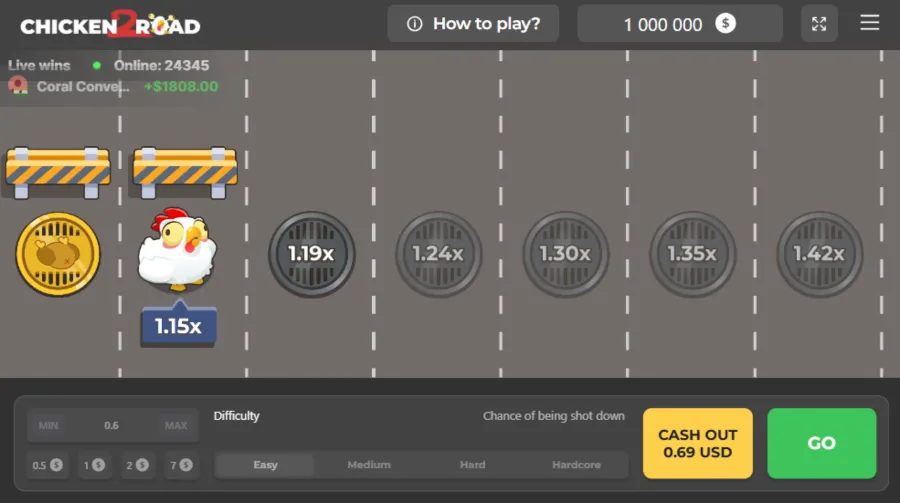
In short sessions, outcomes can swing above or below the theoretical average. That is normal and expected in random systems.
Impact on A$ bankrolls in practical terms
| Total stake volume | 2% model cost | Short-session reality |
|---|---|---|
| A$500 | A$10 | can finish up or down |
| A$2,000 | A$40 | wider swing range |
| A$5,000 | A$100 | closer to model over time |
That is why we focus on exposure control. Good bankroll structure reduces damage from chaotic stretches.





Variance and session swings
Variance drives most emotional mistakes. Players see a streak of low multipliers and assume a big one is “due”. Random models do not work like that.
- Low multipliers can cluster naturally.
- High multipliers are intentionally rare.
- Chasing recovery usually compounds losses.
Chicken Road vs common alternatives
| Format | Typical RTP band | Complexity | Takeaway |
|---|---|---|---|
| Chicken Road | 98% | Low | Strong value + clean controls |
| Other crash titles | 96%-97% | Low | Often higher long-run cost |
| Many slot titles | 94%-96% | Low | Broader variance profiles |
Always verify current game information at the operator level. Providers and operators may revise parameters over time.
Trust and fairness checks Australians should use
Use operators with clear legal pages, transparent terms, and responsive support channels. Keep your own session records instead of relying on social-media myths about multiplier patterns.
Regulatory note: Australian online gambling rules are strict and can evolve. Jurisdiction details should be treated as current-context information, not permanent legal guarantees.
18+ only. For help, call Gambling Help 1800 858 858 or visit gamblinghelponline.org.au.
Australian observations on RTP expectations
Short notes from players who tracked model expectations against actual sessions.
"Once I stopped expecting round-by-round fairness and looked at totals, everything made more sense."
"Variance was the missing piece. I used to overreact after short streaks."
"Tracking total stake and stop rules improved outcomes more than any ‘system’ online."
RTP FAQ
Key RTP questions in plain language.
No. RTP describes long-run value return, not per-round win frequency.
Yes. Short samples are highly variance-sensitive.
No. Strategies change your behaviour and exposure, not the core model RTP.
No, RTP is model-level and independent of device.
Fixed limits, stable stake fractions, and strict stop-loss rules.
Running your own RTP tracking sessions
You can verify Chicken Road’s 98% RTP reference with your own data — but you need enough rounds to produce meaningful results. Short samples are noise; extended samples reveal the model.
How to track effectively
- Record every round: stake, exit multiplier (or crash if you lost), and return.
- After 500 rounds, calculate: total returns ÷ total staked × 100 = your observed RTP.
- Compare to 98%. Small deviations (95%-101%) are normal in a 500-round sample.
- After 2,000+ rounds, your observed figure should converge closer to 98%.
| Sample size | Expected deviation from 98% | Practical meaning |
|---|---|---|
| 50 rounds | ±20-30% | Almost meaningless — pure variance |
| 200 rounds | ±10-15% | Still volatile, do not draw conclusions |
| 500 rounds | ±5-8% | Pattern starts forming |
| 2,000 rounds | ±2-4% | Model convergence visible |
| 10,000+ rounds | ±1-2% | Strong model alignment expected |
This exercise is educational, not a strategy. Your personal RTP tracking cannot change the model — but it can teach you to respect variance and stop reacting emotionally to short-run results.
Simulated session outcomes for A$100, A$250, and A$500 bankrolls
What does Chicken Road’s 98% RTP feel like in sessions of different sizes? These simulations use x2.0 auto cashout with flat 2% bankroll staking to illustrate realistic variance ranges.
| Bankroll | Stake per round | Rounds per session | Best realistic outcome | Worst realistic outcome | Most common outcome |
|---|---|---|---|---|---|
| A$100 | A$2 | 50 | +A$30 to +A$50 | -A$20 to -A$40 | -A$5 to +A$10 |
| A$250 | A$5 | 50 | +A$75 to +A$125 | -A$50 to -A$100 | -A$15 to +A$25 |
| A$500 | A$10 | 50 | +A$150 to +A$250 | -A$100 to -A$200 | -A$30 to +A$50 |
Notice the pattern: "most common outcome" is a small loss or small gain. That is the 2% house edge at work — the model slowly extracting its cost over hundreds of rounds. The best and worst outcomes are where variance lives, and those happen less frequently but feel more impactful.
This is why bankroll sizing and stop-loss rules matter more than any exit strategy. The model cost is modest (2%), but uncontrolled stake increases during bad variance can wipe gains faster than the model alone would suggest.
Why pokies veterans misread crash game RTP
Many Australian players come to Chicken Road from pokies (slot machines), where RTP works similarly on paper but feels completely different in practice.
| Factor | Pokies (typical) | Chicken Road | Key difference |
|---|---|---|---|
| RTP range | 92%-96% | 98% | Chicken Road costs less per dollar staked |
| House edge | 4%-8% | 2% | Half to quarter the model cost of most pokies |
| Player control | None — spin and hope | Direct exit timing | You choose when to cash out |
| Round speed | 3-5 seconds | Seconds to minutes (variable) | Less predictable pacing |
| Jackpot potential | Massive (progressive) | Capped at x150 | Lower ceiling but higher frequency returns |
| Variance feel | Slow drain with rare spikes | Active swings per session | More emotionally demanding |
The critical adjustment for pokies veterans: in crash games, you have agency. Every round requires a decision. In pokies, you press a button and wait. This active involvement means crash games demand more mental discipline per session — which is why structured strategies and strict time limits matter more than they ever did with pokies.
The lower house edge (2% vs 4-8%) is a genuine advantage, but only if you do not cancel it out with undisciplined staking or extended marathon sessions. A$100 through 50 Chicken Road rounds at 2% costs A$2 in model terms. The same A$100 through 50 pokie spins at 6% costs A$6. The maths favours crash games — if behaviour keeps pace.
More Australian RTP feedback
Additional notes from players who tracked their own RTP data over extended sessions.
"Tracked 1,200 rounds and my actual return was 97.3%. Close enough to 98% to confirm the model is fair. Short sessions swung wildly, but the total converged."
"Former pokies player. The comparison table helped me understand why crash games feel more volatile even though the maths is better. Active decisions add stress that pokies do not have."
"The simulation table was eye-opening. I assumed a A$250 bankroll meant I could play all night. In reality, 50 rounds with proper staking is the healthy limit."
RTP mathematics: the full breakdown for Australian players
RTP is a statistical property calculated over millions of rounds. Here is exactly how it works in Chicken Road, broken down from first principles.
The core equation
RTP = (total returns to all players ÷ total stakes from all players) × 100. For Chicken Road: 98% means for every A$1,000,000 staked across all players, A$980,000 is returned and A$20,000 is retained by the model. That retained portion is the house edge.
Per-round expected value
On a single A$2 bet, your expected value is A$2 × 0.98 = A$1.96. You "lose" an average of A$0.04 per round to the model. Over 50 rounds at A$2, the expected model cost is A$2.00. Over 500 rounds, it is A$20.00.
| Rounds played | Total staked (at A$2) | Expected model cost (2%) | Expected return | Variance range (realistic) |
|---|---|---|---|---|
| 50 | A$100 | A$2 | A$98 | A$60-A$140 |
| 100 | A$200 | A$4 | A$196 | A$140-A$260 |
| 500 | A$1,000 | A$20 | A$980 | A$880-A$1,080 |
| 2,000 | A$4,000 | A$80 | A$3,920 | A$3,760-A$4,080 |
The variance range narrows as sample size grows. At 50 rounds, your actual return could be anywhere from A$60 to A$140 — a 80% swing range. At 2,000 rounds, the range tightens to ±5%. This is the law of large numbers in action.
Crash games RTP comparison table
Not all crash games are built equal. RTP differences of 1-2% may seem small, but they compound significantly over hundreds of rounds.
| Game | Provider | RTP | House edge | Cost per A$1,000 staked | Max multiplier | Provably fair |
|---|---|---|---|---|---|---|
| Chicken Road | Turbo Games | 98% | 2% | A$20 | x150 | Yes |
| Aviator | Spribe | 97% | 3% | A$30 | Unlimited | Yes |
| JetX | SmartSoft | 97% | 3% | A$30 | Unlimited | Yes |
| Spaceman | Pragmatic Play | 96.5% | 3.5% | A$35 | x5,000 | No |
| Cash or Crash | Evolution | 99.5% | 0.5% | A$5 | x50,000 | No |
| Plinko | Spribe | 97% | 3% | A$30 | x1,000 | Yes |
| Mines | Spribe | 97% | 3% | A$30 | Variable | Yes |
Chicken Road's 2% house edge sits near the top of the crash game category. Only Cash or Crash (Evolution) offers a lower edge, but that game uses a different mechanic — live dealer with fixed rounds rather than continuous multiplier climbing.
Over 1,000 rounds at A$2: Chicken Road costs A$40 in model terms. Aviator costs A$60. Spaceman costs A$70. That A$30 difference between Chicken Road and Spaceman buys you 15 extra rounds of play at A$2 stakes — or less pressure on your bankroll during bad variance streaks.
Variance explained: why short sessions feel unfair
Variance is the statistical term for how much your actual results deviate from the expected value. High variance means wild swings. Low variance means results cluster near the average.
Chicken Road has medium-high variance because the crash point distribution is asymmetric: many rounds crash at low multipliers (x1.0-x1.5), a moderate number reach x2.0-x5.0, and very few reach x10+. This creates a skewed experience where losing rounds feel more frequent than winning rounds at higher targets — which is mathematically correct.
Variance visualised across 50-round sessions
| Session outcome | Probability (x2.0 target, A$2 stake) | Balance change | How it feels |
|---|---|---|---|
| Strong positive (+20% or more) | ~15% of sessions | +A$20 to +A$50 | Feel like a genius |
| Mild positive (+1% to +19%) | ~25% of sessions | +A$1 to +A$19 | Satisfied, controlled |
| Near breakeven (-5% to +5%) | ~20% of sessions | -A$5 to +A$5 | Neutral, maybe slightly flat |
| Mild negative (-1% to -19%) | ~25% of sessions | -A$1 to -A$19 | Annoying but manageable |
| Strong negative (-20% or worse) | ~15% of sessions | -A$20 to -A$40+ | Frustrating, tilt risk high |
The critical insight: 40% of sessions will be mildly or strongly negative. This is not a flaw in the game or your strategy — it is the mathematical reality of a random system. Players who accept this beforehand handle bad sessions far better than those who expect every session to be positive.
Provably fair technical details for serious players
Chicken Road uses a cryptographic provably fair system that allows individual round verification. Here is how the system operates at a technical level.
How the crash point is generated
- Server seed generation: before each round, the server generates a random seed and creates a SHA-256 hash of that seed. The hash is published before the round starts — players can see it but cannot derive the seed from the hash.
- Client seed contribution: the player's browser contributes a client seed (often generated automatically). This ensures the server cannot unilaterally control the outcome.
- Crash point calculation: the server seed and client seed are combined using HMAC-SHA256. The resulting hash is converted to a number that determines the crash multiplier.
- Post-round verification: after the round, the server reveals its seed. You can independently hash the server seed, verify it matches the pre-committed hash, and confirm the crash point was correctly derived.
In practical terms, this means:
- The operator cannot change the crash point after seeing your bet.
- The crash point was fixed before you decided to enter the round.
- You can verify this independently using third-party hash verification tools.
- The 98% RTP is a property of the mathematical distribution, not a dial the operator adjusts.
This is fundamentally different from traditional pokies, where you must trust external auditor reports. In Chicken Road, trust is replaced by mathematical verification. If you are technically inclined, verify 50-100 rounds yourself. The crash points will match the pre-committed hashes every time.
For Australian players concerned about fairness after bad streaks: verify the rounds. If the hashes match, the game operated correctly. Bad streaks are variance, not manipulation.
Cost comparison: Chicken Road vs pokies and other Australian gambling formats
Australian players have access to many gambling formats. Understanding the cost difference per dollar staked helps you make informed choices about where your leisure budget goes.
| Format | Typical RTP | House edge | Cost per A$100 staked | Cost per A$1,000 staked | Player control |
|---|---|---|---|---|---|
| Chicken Road | 98% | 2% | A$2 | A$20 | Exit timing (high) |
| Other crash games (avg) | 96.5-97% | 3-3.5% | A$3-A$3.50 | A$30-A$35 | Exit timing (high) |
| Online pokies | 94-96% | 4-6% | A$4-A$6 | A$40-A$60 | None (press spin) |
| Pub/club pokies (AU) | 87-92% | 8-13% | A$8-A$13 | A$80-A$130 | None |
| Roulette (European) | 97.3% | 2.7% | A$2.70 | A$27 | Bet selection only |
| Blackjack (basic strategy) | 99.5% | 0.5% | A$0.50 | A$5 | Decision-based (high) |
| Sports betting | ~90-95% | 5-10% | A$5-A$10 | A$50-A$100 | Research-based |
The standout comparison for Australian players: pub and club pokies — the most common form of gambling in Australia — cost A$80-A$130 per A$1,000 staked. Chicken Road costs A$20 for the same volume. That is a 4-6x cost difference. Over a year of regular play, this gap translates to hundreds or thousands of dollars.
However, cost per dollar staked is only one factor. Speed of play matters too. If crash game speed causes you to stake A$500 in a session where you would only stake A$200 on pokies, the lower per-unit cost is cancelled by higher volume. This is why session time limits and stake caps are essential regardless of format.
RTP myths that cost Australian players money
Misunderstanding RTP leads to costly decisions. Here are the five most common myths and the reality behind each.
| Myth | Reality | Why it costs money |
|---|---|---|
| "98% RTP means I win 98% of rounds" | RTP measures total returns over millions of rounds, not per-round win rate | Players expect constant wins and tilt when normal losses occur |
| "After a losing streak, a big win is overdue" | Each round is independent — the algorithm has no memory of previous results | Players increase stakes during losing streaks, compounding losses |
| "RTP is higher at certain times of day" | RTP is a fixed mathematical property — it does not change by time, day, or player count | Players chase "hot periods" and play at suboptimal times (late night when fatigue is high) |
| "Higher stakes get better RTP" | RTP applies equally to all stake sizes | Players increase stakes believing they are receiving better odds |
| "Demo mode has different RTP than live" | Turbo Games uses the same provably fair model for demo and live | Players dismiss demo results as unrealistic and skip practice |
Every myth on this list leads to the same outcome: players staking more than they should, in situations they should avoid, based on beliefs that are mathematically incorrect. Understanding RTP correctly does not help you win more — it helps you lose less by avoiding decisions based on false premises.
If you find yourself believing any of these myths during a session, stop playing. Review this section. Then restart with a clear understanding of what 98% RTP actually means: a modest, long-term mathematical cost — not a per-session win guarantee.
How RTP affects bankroll longevity across session sizes
One practical way to understand 98% RTP: it tells you how long your bankroll will last under controlled conditions. A lower house edge means more rounds per dollar deposited.
| Starting bankroll | Stake per round | Expected rounds before model depletes bankroll (no variance) | At Chicken Road 2% | At pokies 6% |
|---|---|---|---|---|
| A$100 | A$2 | Bankroll ÷ (stake × edge) | 2,500 rounds | 833 rounds |
| A$200 | A$4 | — | 2,500 rounds | 833 rounds |
| A$500 | A$10 | — | 2,500 rounds | 833 rounds |
At 2% house edge with A$2 stakes, your A$100 bankroll theoretically sustains 2,500 rounds before the model cost depletes it. At 6% pokies edge, the same bankroll lasts only 833 rounds. That is 3x more playing time at Chicken Road — assuming flat staking and no variance.
Variance changes this dramatically. Good variance extends your bankroll beyond the model estimate. Bad variance shortens it. But the mathematical foundation remains: lower house edge = more rounds per dollar, which means more entertainment value, more data, more time to execute your strategy, and slower erosion of your leisure budget.
For Australian players comparing options: if you typically spend A$100 at the pokies on a Friday night and get 2 hours of play, the same A$100 at Chicken Road with disciplined A$2 staking could sustain 3-4 evenings of 25-minute sessions. The cost per hour of entertainment is significantly lower — if discipline holds.
18+ only. If you struggle to maintain discipline, seek support from Gambling Help on 1800 858 858.
Applying RTP knowledge to daily session decisions
Understanding RTP is only useful if it changes how you play. Here are five concrete decisions that RTP knowledge should influence in every session.
1. Game selection
If an operator offers multiple crash games, choose the highest RTP. Playing Chicken Road at 98% instead of a 96% alternative saves A$20 per A$1,000 staked. Over a month of regular play, that difference is significant.
2. Stake sizing
RTP tells you the long-run cost rate. At 2% house edge with A$5 stakes and 50 rounds per session, your expected model cost per session is A$5. If you cannot afford that A$5 comfortably, reduce your stake. If a A$5 session cost feels trivial, your session bankroll supports that level.
3. Session length
The model cost accumulates per round. More rounds = more total model cost. A 25-round session at A$2 costs A$1 in expected terms. A 100-round session costs A$4. Shorter sessions limit your exposure and keep decision quality higher.
4. Bonus evaluation
RTP determines whether a bonus has positive or negative expected value. At 98% RTP: a A$100 bonus with 35x wagering costs A$70 in model terms, netting A$30 in expected value. At 95% RTP: the same bonus costs A$175 — netting negative A$75. RTP knowledge turns bonus evaluation from guesswork into arithmetic.
5. Stop-loss calibration
Your stop-loss should reflect realistic variance. At 98% RTP with x2.0 exits, a -20% session drawdown is within normal variance range. If you set stop-loss at -5%, you will trigger it almost every session. Set it at -50% and you are absorbing too much risk. The -20% level balances between stopping too early and allowing too much damage.
RTP is not abstract theory. It is the cost structure of every round you play. Treat it as the foundation for every session decision, not background information you read once and forget.