

Chicken Road Demo for Australians
Use practice mode to build consistent exits and test bankroll rules before adding real financial pressure.

Why demo mode matters for real outcomes
Demo rounds are where you fix behavioural leaks without cost. You can test reaction speed, exit discipline, and stake consistency before real money introduces stress.
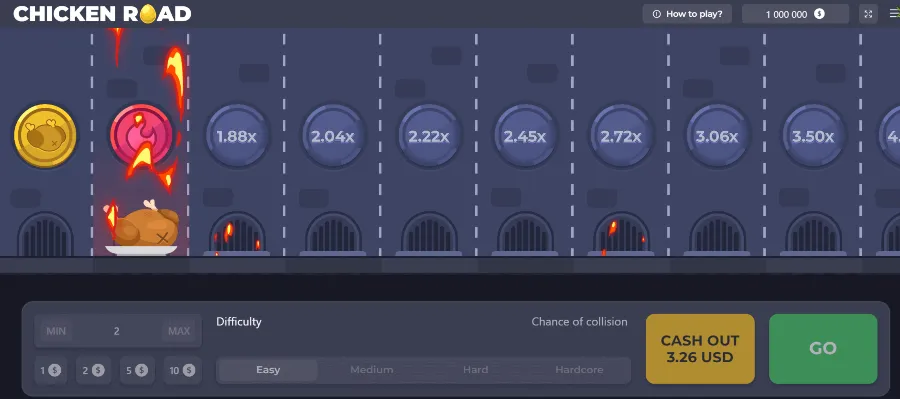
Players who skip demo often learn basic discipline with live funds, which is the expensive way to learn.
How to launch the demo in under a minute
- Tap Play in the demo frame above.
- Set a low virtual stake and one fixed exit target.
- Run 30-50 rounds without changing your target.
- Review outcomes, then repeat with one adjustment only.
Simple process, better data. Keep notes while you practise.





7-day practice plan for Australian beginners
- Day 1: 50 rounds at x1.8, stable stake.
- Day 2: 50 rounds at x2.0, track hit rate.
- Day 3: compare manual exits vs auto cashout.
- Day 4: two short sessions with strict breaks.
- Day 5: simulate stop-loss and stop-win triggers.
- Day 6: test control after five losses in a row.
- Day 7: review data and decide if live play is justified.
When to switch from demo to live play
Move only when you can hold one plan through a full session without emotional overrides. If you keep changing targets after random streaks, stay in demo.
Australia has strict online gambling controls and ad standards. Treat live play as higher-risk financial activity, not entertainment-only autopilot.
18+ only. Need support? Gambling Help: 1800 858 858 — gamblinghelponline.org.au.
Australian demo feedback
Short notes from players who practised before going live.
"Demo mode showed me my worst habit straight away: increasing stake after two losses."
"Once I ran structured demo blocks, live sessions felt far less chaotic."
"Free practice is basically tuition. Skipping it costs money later."
Demo FAQ
Practical answers for first-time players.
Yes. This practice mode is free and does not use real money.
No. Demo balances are virtual and not withdrawable.
A practical baseline is at least 200 structured rounds.
Yes. It helps train repeatable exits and reduce impulse decisions.
Going live without a written plan for stake, exit target, and stop-loss.
Demo versus live play: what actually changes
Demo and live rounds use the same interface, but the psychological load is entirely different. Practice mode removes financial consequence, which means your decision quality in demo is your ceiling — not your floor — for live sessions.
| Factor | Demo mode | Live play | Key difference |
|---|---|---|---|
| Financial risk | None | Real A$ at stake | Emotional pressure rises sharply |
| Decision quality | Usually higher | Degrades under stress | Practise builds the baseline |
| Session discipline | Easier to maintain | Requires pre-commitment | Demo trains the habit loop |
| Exit timing | Consistent | Prone to late exits | Auto cashout compensates in live |
| Tilt risk | Low | High after losing streaks | Demo teaches streak recognition |
Australian players who treat demo as a genuine training tool — not just a brief preview — consistently report steadier live results. The transition works best when you replicate your exact demo rules in the first five live sessions.
Device-specific demo performance across Australia
Chicken Road demo runs on both mobile and desktop browsers, but the experience differs in ways that matter for building habits.
Mobile (iOS and Android)
- Touch cashout timing is slightly less precise than mouse clicks — practise tap rhythm in demo first.
- Use Wi-Fi or strong 4G/5G. Unstable regional connections (common outside metro areas in Sydney, Melbourne, Brisbane) can introduce lag spikes.
- Close competing apps to avoid notification interruptions mid-round.
- Short demo blocks (10-15 minutes) suit mobile better than marathon sessions.
Desktop
- Mouse-based cashout feels faster for most players.
- Larger screen supports better data tracking alongside the game frame.
- Ideal for the 7-day practice plan where you need a notepad or spreadsheet open at the same time.
Whichever device you prefer for live play, run your demo blocks on the same device. Muscle memory and interface familiarity transfer directly.
Australian regulatory context for demo play
Australia's Interactive Gambling Act 2001 primarily targets operators, not individual players. Demo mode is entirely risk-free and involves no real money, making it the safest starting point for anyone curious about crash games.
Under ACMA enforcement, operators serving Australians must meet specific standards. Demo access itself is unregulated since no financial transaction occurs, but the transition to live play means entering a regulated environment. Use demo time to evaluate whether the operator behind the game meets the trust standards outlined on our scam check page.
For players who have previously used pokies at pubs or clubs, online crash game demo mode is a useful bridge. The skill component (exit timing, stake discipline) is entirely new compared to pokies, and demo rounds let you build that skill without the house edge costing you real Australian dollars.
How to track your demo data like a serious player
Random demo rounds teach you nothing. Structured demo rounds with recorded data teach you everything about your own tendencies.
| What to log | Why it matters | Ideal sample |
|---|---|---|
| Exit multiplier per round | Shows if you stick to your plan | 50+ rounds per target |
| Stake consistency | Flags emotional stake changes | Check after every 20 rounds |
| Break compliance | Trains session discipline | Log every break taken or skipped |
| Tilt triggers | Identifies your vulnerable moments | Note after every losing streak of 5+ |
After 200 tracked rounds, review your data. If exit consistency exceeds 80% — meaning you hit your planned target at least 80% of the time without emotional deviation — you have a reasonable foundation for cautious live play.
If your data shows frequent plan breaks, stay in demo. There is no cost to practising longer, and significant cost to going live unprepared.
More demo feedback from Australian players
Additional notes from players who completed structured demo training.
"Logging every round in demo felt tedious, but the data showed exactly where I break my own rules. Fixed it before spending real dollars."
"Desktop demo with my spreadsheet open was the best setup. Mobile demo was fine for short practice blocks on the train."
"The comparison table made me realise demo skill does not automatically transfer. You need to replicate the exact same rules in live."
Structured demo practice plan: 500-round mastery protocol
The 7-day plan on this page covers basics. For players who want deeper preparation, here is a 500-round protocol that builds all core skills before live play.
| Phase | Rounds | Focus | Exit target | Success metric |
|---|---|---|---|---|
| Phase 1: Consistency | 1-100 | Hit one fixed exit target repeatedly | x1.8 only | 80%+ exit accuracy (hit target without override) |
| Phase 2: Comparison | 101-200 | Compare manual vs auto cashout | x2.0 (manual first 50, auto next 50) | Which method produces more consistent results? |
| Phase 3: Stress test | 201-300 | Maintain discipline through losing streaks | x2.0 | No stake changes during 10+ loss streaks |
| Phase 4: Session structure | 301-400 | Practice full sessions with stop-loss/stop-win | x2.0 | 100% compliance with stop triggers |
| Phase 5: Review | 401-500 | Free practice using your chosen strategy | Your choice | Positive or breakeven net across 100 rounds |
If you fail a phase's success metric, repeat it before moving on. There is zero cost to extending demo practice. The cost of moving to live play unprepared is real Australian dollars.
Charlotte from Perth completed the full 500-round protocol over 10 days. Her phase 1 exit accuracy was 73% — below the 80% threshold. She repeated it and hit 86% on the second attempt. By phase 5, her net result across the final 100 rounds was +4% virtual bankroll. She started live play at A$0.50 stakes and maintained positive results for the first three weeks.
Demo mode limitations you must understand
Demo mode is the best free training tool available, but it has specific limitations that affect how your practice translates to live play.
| Limitation | Why it matters | How to compensate |
|---|---|---|
| No financial pressure | Emotional decision-making is absent in demo | Treat virtual stakes as real — follow the same rules you would with A$ |
| Unlimited balance resets | You never face the consequence of a blown bankroll | Set a virtual bankroll limit and stop if it is exceeded |
| No withdrawal testing | You cannot evaluate operator withdrawal speed in demo | Test withdrawals separately with a small A$30 real deposit |
| Potentially different RNG | Some operators use a separate RNG for demo — though Turbo Games uses the same provably fair model | Verify by checking if demo offers provable fairness hashes |
| No tilt simulation | Losing virtual money does not trigger real emotional responses | Intentionally practise 10-round loss streaks and monitor your impulse to change the plan |
The biggest gap between demo and live play is emotional, not mechanical. The same player who calmly maintains x2.0 exits in demo will hold past x3.0 in live play because "this one feels like it is going higher." Practice cannot fully simulate this pressure — but it can train the habit of following a written plan, which transfers to live play as a decision framework.
Using demo to test strategy configurations
Before deploying any strategy with real money, test it in demo with enough rounds to produce meaningful data. Here is a framework for systematic strategy testing.
Strategy A/B testing protocol
- Choose two strategy configurations to compare (e.g., x1.8 flat stake vs x2.0 with anti-Martingale).
- Run 100 rounds with Configuration A. Log: starting balance, ending balance, max drawdown, number of stop-loss triggers, exit accuracy.
- Run 100 rounds with Configuration B using the same metrics.
- Compare results. The better strategy is not necessarily the one that made more — it is the one with better discipline metrics and smaller drawdowns.
| Metric | Configuration A (x1.8 flat) | Configuration B (x2.0 anti-Martingale) | What to look for |
|---|---|---|---|
| Net result after 100 rounds | Record actual | Record actual | Higher net is better, but not decisive alone |
| Max drawdown | Record actual | Record actual | Lower drawdown = safer for real play |
| Stop-loss triggers | Count | Count | Fewer triggers = strategy fits your bankroll |
| Exit accuracy | % of planned exits hit | % of planned exits hit | Higher accuracy = better execution |
| Emotional comfort | Rate 1-5 | Rate 1-5 | A strategy you cannot follow is useless |
Noah from Gold Coast tested three configurations over 300 demo rounds each. His x1.8 conservative approach had the smallest max drawdown (-12% vs -23% for x2.5 aggressive). He went live with the conservative setup and adjusted only after accumulating 500+ live rounds of data.
Demo-to-live transition protocol
The transition from demo to real money is the highest-risk moment in a new player's journey. A structured protocol reduces the shock and prevents common first-session mistakes.
Week 1 transition steps
- Day 1: Deposit A$50 maximum. Set deposit limit immediately so you cannot add more in the first week.
- Day 1: Play 20 rounds at A$0.30 (minimum stake). Use the exact same exit target and strategy from your most successful demo phase.
- Day 2: Review your first live session. Did you stick to the plan? If not, return to demo for another 100 rounds.
- Day 3-4: If session 1 was disciplined, play two more sessions at A$0.30. Same rules, same exit target.
- Day 5-7: If three consecutive sessions were disciplined, increase to A$0.50. Maintain all other parameters.
The key principle: increase exposure only as a reward for demonstrated discipline, never as a reaction to results. Jack from Melbourne followed this protocol and did not reach A$2 stakes until his fourth week of live play. His monthly result for that first month was -1.8% — almost exactly the 2% model cost, which means his behaviour added almost zero extra cost.
If your first live session involves panic stake increases, late exits, or ignored stop-losses, return to demo. There is no timeline pressure. The game will still be here next week.
18+ only. If the transition to real money feels overwhelming, contact Gambling Help on 1800 858 858 or visit gamblinghelponline.org.au.
Demo bankroll simulation: testing your strategy with virtual A$ amounts
Demo mode usually displays an arbitrary virtual balance (often $10,000). To make demo practice realistic, impose your actual planned bankroll size on the virtual balance.
How to run a realistic simulation
- Decide your real starting bankroll: say A$100.
- Calculate your stake at 2%: A$2 per round.
- In demo, ignore the displayed virtual balance. Track your own simulated balance on paper or in a spreadsheet starting at A$100.
- After each round, update your tracked balance. If you win A$2 × x1.8 = A$3.60, add A$1.60 profit. If you lose, subtract A$2.
- When your tracked balance hits your stop-loss (-20% = A$80), stop the session — even though the demo's virtual balance still has thousands remaining.
- When your tracked balance hits your stop-win (+30% = A$130), stop the session.
| Simulation parameter | A$50 bankroll | A$100 bankroll | A$250 bankroll |
|---|---|---|---|
| Stake per round (2%) | A$1 | A$2 | A$5 |
| Stop-loss (-20%) | A$40 | A$80 | A$200 |
| Stop-win (+30%) | A$65 | A$130 | A$325 |
| Max rounds per session (25 min) | ~40-50 | ~40-50 | ~40-50 |
This exercise transforms demo from casual button-pressing into genuine strategy testing. After 5 simulated sessions, you will have realistic data on how your strategy performs at your actual bankroll level — not an inflated virtual fantasy.
Olivia from Perth ran 10 simulated sessions using her planned A$150 bankroll. Her results ranged from -A$18 (worst) to +A$31 (best), with an average of +A$3 per session. The simulation showed her that the x2.0 exit target she planned was sustainable at her bankroll level. She started live play with confidence backed by data.
Common demo questions Australian beginners ask
Can I reset my demo balance?
Most operators allow unlimited demo balance resets. Some reset automatically when you revisit. This is convenient for free practice but dangerous if it removes the incentive to manage virtual funds carefully. Treat every demo session as if resets are not available — manage the balance like real money.
Does demo performance predict live results?
Not directly. Demo and live use the same RTP model (98%), but the emotional variable is absent in demo. Your demo results represent your ceiling — the best you can perform when no financial pressure exists. Live results are typically 2-5% worse due to behavioural slippage under real money conditions.
How long should I stay in demo before going live?
Minimum 200 structured rounds (about 3-5 sessions). Ideally 500 rounds using the mastery protocol. If your exit accuracy is above 80% and your stop-loss compliance is 100%, you have a reasonable foundation for cautious live play at minimum stakes.
Should experienced crash game players still use demo?
Yes — but for different purposes. Experienced players use demo to test new exit targets, compare strategy configurations, and recalibrate after long breaks. A 50-round demo warm-up after a week away helps reset muscle memory and decision patterns before committing real A$.
Demo is not a crutch. It is a risk-free laboratory for building, testing, and maintaining the skills that protect your bankroll in live sessions.
Building the right demo mindset
The biggest mistake Australian beginners make with demo mode is treating it as entertainment rather than training. The mindset difference determines whether demo practice actually transfers to live play.
Entertainment mindset (ineffective)
- Clicking randomly, trying different stakes and exits with no plan.
- No logging, no tracking, no rules.
- Resetting virtual balance whenever it drops.
- Playing with friends as a casual social activity.
This approach teaches you nothing about your own decision patterns. You emerge from 200 demo rounds with zero useful data.
Training mindset (effective)
- Every session starts with a written plan: stake, exit target, stop-loss, timer.
- Results logged after each session. Patterns reviewed weekly.
- Virtual balance treated as finite — no resets mid-session.
- Deliberate practice of specific skills: exit consistency, tilt resistance, break compliance.
Charlotte from Brisbane spent her first week in demo with the entertainment mindset — 500 casual rounds, no notes, random targets. She learned nothing. Week two, she switched to the training mindset: 50 rounds daily, x1.8 fixed target, full logging. By day 7 of structured practice, her exit accuracy was 88% and she had clear data showing where her emotional triggers appeared.
The same 500 rounds in each approach. Completely different outcomes. The demo mode is identical — the player's intention is the variable.
If you are spending time in demo, spend it with intention. Every round without a plan is a round wasted — and wasted demo rounds just delay the point where you are genuinely prepared for live play with real Australian dollars at stake.