

Chicken Road Demo: Free Practice for UK Players
Use the no-risk mode to sharpen exits, test bankroll rules, and see how variance feels before using live funds.

Why demo mode matters
Demo rounds are where you build decision quality. You learn pace, timing pressure, and the emotional urge to overstay. That is valuable because mistakes in demo cost nothing.
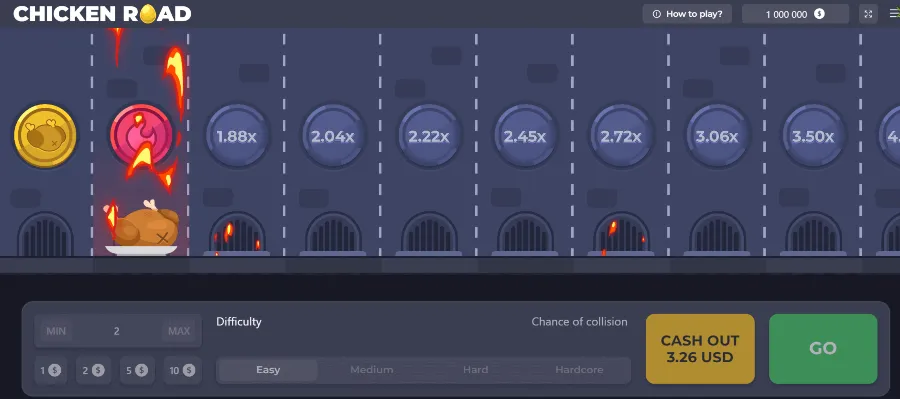
Many new players rush into live play with no routine. The usual outcome is avoidable loss, then frustration. Demo mode lets you establish repeatable behaviour first.
How to access the free demo
- Open this page and tap Play above.
- Wait for the demo frame to load.
- Set a simple target such as x1.8 or x2.0.
- Run 30-50 rounds and note outcomes.
No account is needed for practice mode here. If you switch to operator-hosted demo versions, some sites may ask for a free account first.





Demo vs live cash play
| Area | Demo | Live |
|---|---|---|
| Financial risk | None | Real |
| Psychological pressure | Low | High |
| Learning value | Excellent | Costly if unprepared |
| Winnings | Not withdrawable | Withdrawable subject to terms |
Mechanics are aligned. The big difference is emotional load. In live sessions, pressure distorts judgement faster than most players expect.
Demo vs real money: the full comparison
The game engine running in demo mode uses the same provably fair algorithm as live play. Crash points follow the same 98% RTP distribution. Your demo session at x1.9 auto cashout will produce statistically similar hit rates to a live session at the same target. The mathematics are identical.
What differs is everything outside the algorithm:
| Factor | Demo mode | Live play | Why it matters |
|---|---|---|---|
| Emotional intensity | Low — no real stake | High — real £ at risk | Emotions cause 80%+ of strategy deviations |
| Loss reaction | Neutral — "it's practice" | Strong — urge to chase | Chasing losses is the #1 bankroll destroyer |
| Win reaction | Mild satisfaction | Euphoria, overconfidence | Post-win stake increases lead to exposure spikes |
| Session discipline | Easy to follow rules | Rules feel restrictive under pressure | Pre-written plans prevent in-session improvisation |
| Cashout execution | Calm, timed | Hesitant, second-guessing | Auto cashout removes the hesitation problem |
| Withdrawal cycle | Not applicable | Deposit→play→verify→withdraw | Test the full cycle with a small real deposit first |
The transition from demo to live is where most UK beginner losses occur. Players who perform well in demo assume they will replicate that performance with real money. The data says otherwise — first live sessions typically show 15-25% worse outcomes than equivalent demo sessions, purely due to emotional interference.
What to practise specifically in demo mode
- Auto cashout consistency: Set x1.8 and run 50 rounds without changing it. Track how many times you wanted to override it. That count is your emotional interference baseline.
- Manual cashout timing: In a separate 50-round block, use manual cashout only. Record the multiplier you actually exit at versus your intended target. The gap between intention and execution reveals your timing discipline.
- Loss streak behaviour: Deliberately play through a bad run of 10+ losses. Monitor whether you feel the urge to increase stakes or switch targets. If you do, that is the exact behaviour you need to control before going live.
- Session exit discipline: Set a 20-minute timer. When it rings, close the game — even if you are mid-streak. Practising this exit in demo makes it habitual before real money is involved.
- Stop-loss execution: Start with 1,000 demo credits. Set a -20% stop-loss (stop at 800). Play until you either hit the stop-loss or complete 30 rounds. The purpose is to test whether you actually stop when the condition is met.
Limitations of demo mode
Demo mode is a learning tool, not a prediction tool. Understanding its limitations prevents overconfidence when transitioning to live play.
- No emotional calibration: Demo cannot simulate the feeling of losing £50 in 15 minutes. That emotional response only appears with real stakes. Acknowledging this gap in advance is the first step to managing it.
- No withdrawal process testing: You cannot practise the deposit→play→verify→withdraw cycle in demo. Complete this cycle with a small real deposit (£10-£20) as a separate exercise.
- Potentially different auto cashout behaviour: Some demo implementations may have slight interface differences from the live version at a specific casino. Verify your chosen operator's interface before scaling up stakes.
- Unlimited virtual balance: In demo, running out of credits simply resets. In live play, losing your session bankroll ends the session. The psychological weight of a depleting real balance cannot be replicated virtually.
- No bonus interaction: Wagering requirements, maximum bet limits during bonus play, and contribution percentages only apply in live mode. If your strategy involves bonus funds, the parameters are different from free demo play.
Despite these limitations, demo remains the single best preparation tool. Every UK player interviewed who used 200+ demo rounds before their first live deposit reported feeling more prepared than those who skipped practice entirely.
Demo strategy testing protocol
Use demo mode to test strategy variables systematically before committing real GBP. This protocol takes 7-10 days and produces actionable data.
Week 1: Baseline testing
| Day | Target | Rounds | What to record |
|---|---|---|---|
| 1 | x1.5 auto cashout | 50 | Win count, ending balance, emotional notes |
| 2 | x1.8 auto cashout | 50 | Win count, ending balance, emotional notes |
| 3 | x2.0 auto cashout | 50 | Win count, ending balance, emotional notes |
| 4 | x2.5 auto cashout | 50 | Win count, ending balance, emotional notes |
| 5 | x3.0 auto cashout | 50 | Win count, ending balance, emotional notes |
| 6-7 | Your preferred target | 100 | Full session log including discipline rating |
After one week, you will have 350 rounds of data across five cashout levels. Compare balance trajectories, emotional comfort, and consistency of execution. The target where your ending balance is closest to expected (calculated from hit frequency × payout) AND where your discipline rating is highest is your optimal starting framework.
Harry from Glasgow tested all five levels over 10 days. His data showed x1.8 produced the best balance trajectory, but x2.0 scored highest on his discipline scale because the rhythm felt more natural. He chose x2.0 for his first live sessions and maintained it for six weeks before adjusting.
If gambling starts to feel concerning at any point — even in demo — contact GamCare at 0808 8020 133 or visit begambleaware.org. GamStop provides free self-exclusion from all UKGC-licensed operators.
Structured 5-session demo practice plan
This plan takes 5 sessions across 5-7 days. Each session is 30-40 minutes. By the end, you will have 300+ rounds of tracked data and a clear picture of which cashout target suits your decision style.
| Session | Focus | Rounds | Settings | What to record |
|---|---|---|---|---|
| 1: Observation | Watch crash point distribution | 30 rounds (no betting) | Spectate only | How many rounds crash below x1.5, x2.0, x3.0 |
| 2: Conservative | Low-target auto cashout | 60 rounds | x1.5 auto cashout, £1 flat | Win rate, ending balance, emotional state |
| 3: Balanced | Standard auto cashout | 60 rounds | x2.0 auto cashout, £1 flat | Win rate, ending balance, override urges |
| 4: Manual | Manual cashout decisions | 60 rounds | Manual only, £1 flat, target x2.0 | Actual cashout multiplier vs target per round |
| 5: Stress test | Loss streak discipline | 100 rounds | x1.8 auto, £1 flat, -20% stop-loss | Did you stop at -20%? Time to decision |
Session 1: Observation (no money at risk)
Open the demo and watch 30 rounds without placing any bets. Record how many rounds crash below x1.5 (typically 35-40%), how many reach x2.0+ (typically 45-50%), and how many reach x5.0+ (typically 18-20%). This gives you a baseline distribution before your own decisions introduce bias.
Session 2: Conservative play at x1.5
Set auto cashout to x1.5 and place 60 rounds at £1. Expected win rate: approximately 62-65%. Expected ending balance: roughly break-even or slightly negative (the house edge still applies). The purpose is to feel the rhythm and build confidence with a high-frequency win pattern.
Session 3: Balanced play at x2.0
Increase auto cashout to x2.0 for 60 rounds. Expected win rate drops to 45-50%. Losses cluster more noticeably. Record how many times you wanted to lower the target after a losing streak. That urge count is your emotional vulnerability metric.
Session 4: Manual cashout challenge
Disable auto cashout and attempt to manually exit at x2.0 for 60 rounds. Record your actual exit multiplier each round. Most beginners exit early (x1.3-x1.7) out of nervousness or late (x2.5-x3.0) out of greed. The gap between your target and actual execution reveals how much auto cashout benefits your play.
Session 5: Stop-loss stress test
Start with 1,000 credits. Set a -20% stop-loss (stop at 800 credits). Play 100 rounds or until stop-loss triggers — whichever comes first. If the stop-loss triggers, the test measures whether you actually stop. This is the most important session because it tests the discipline that matters most in live play.
After all 5 sessions, compare your data. The target where your balance trajectory was most stable AND where your discipline rating was highest is your recommended starting framework for live play.
What beginners should test in demo mode
New players often use demo mode randomly — placing bets at various amounts with no structure. This wastes the learning opportunity. Focus your demo time on these five specific skills:
1. Auto cashout consistency (priority: high)
Set one target (x1.8 is a good start) and run 50 rounds without changing it. The purpose is to build the habit of committing to a plan. If you change the target mid-session, note why. "Boredom" and "feeling unlucky" are the most common reasons — both are emotional, not strategic.
2. Bankroll depletion speed (priority: high)
Start with 500 demo credits and bet 2% per round (10 credits). Track how quickly your balance fluctuates. In 50 rounds, you should see swings of ±15-25% — this is normal variance, not a sign of anything wrong. Learning what normal looks like prevents panic during live sessions.
3. Session exit discipline (priority: critical)
Set a timer for 20 minutes. When it rings, close the demo — even if you are on a winning streak. Practise this exit 3 times. If you cannot stop a free demo on time, you will not stop a live session on time. This is the single most predictive test of future live performance.
4. Loss reaction observation (priority: high)
Deliberately play through a 10+ losing streak (these happen naturally at x2.0 targets — about once every 20-30 rounds you will see 6-8 consecutive losses). Watch your own reaction. Do you want to increase the stake? Switch to a higher target? Play faster? Each of these impulses is a leak that costs real money in live play.
5. Interface familiarisation (priority: medium)
Test every button and setting: auto cashout on/off, stake adjustment, game history, provably fair verification (if available in demo). Know where everything is before real money is involved. Rebecca from Cardiff spent 10 minutes on interface familiarisation and said it prevented "at least three mistimed clicks" during her first live week.
Transitioning from demo to live: the protocol
Moving from demo to live is where 60-70% of beginner mistakes happen. This protocol minimises the transition risk.
Pre-transition checklist
- Completed 200+ demo rounds with consistent rules? If no, continue practising.
- Can you stop a session on time 3 out of 3 attempts? If no, practise exit discipline.
- Identified your optimal cashout target from data? If no, run comparison sessions.
- Set a real-money budget you can afford to lose entirely? If no, do not transition yet.
- Chosen a UKGC-licensed casino and completed KYC? If no, handle this before first deposit.
First live session rules
| Parameter | Demo value | First live session | Why the change |
|---|---|---|---|
| Stake per round | £1 (virtual) | £0.50 (real) | Halve your demo stake to absorb emotional impact |
| Session length | 50-100 rounds | 25 rounds maximum | Shorter sessions reduce emotional fatigue |
| Stop-loss | -20% | -15% | Tighter stop-loss while adjusting to real stakes |
| Cashout target | Your tested target | Same target | Only change one variable at a time (stake size) |
| Session count | 5+ sessions | 3 sessions in first week | Space sessions to process emotional reactions |
The £10 test deposit
Your first real deposit should be small — £10 is ideal. This tests the full cycle: deposit → play → verify → withdraw. Even if you win £3 on your £10, withdraw the entire £13. The purpose is to confirm the process works, not to build a bankroll. Nathan from Leeds did this and discovered his chosen casino's PayPal withdrawal took 6 hours — useful knowledge before committing larger amounts.
After 3-5 successful live sessions at minimum stakes, gradually increase to your planned stake size over 2-3 weeks. If at any point you break your own rules (exceed stop-loss, change target mid-session, chase losses), return to demo for 50 rounds before resuming live play.
Demo session tracking: what to record and why
Raw demo play without tracking produces nothing useful. A simple tracking system turns practice rounds into actionable data. Use a notes app, spreadsheet, or pen and paper — the format does not matter, consistency does.
What to record per session
| Field | Example | Why it matters |
|---|---|---|
| Date and time | 28 Mar 2026, 7:30pm | Reveals time-of-day patterns in your decision quality |
| Cashout target | x1.8 auto | Tracks consistency across sessions |
| Rounds played | 60 | Confirms you are reaching target practice volume |
| Starting balance | 1,000 credits | Baseline for net result calculation |
| Ending balance | 1,034 credits | Net result: +34 credits (+3.4%) |
| Win rate | 33/60 = 55% | Compare against theoretical for your target |
| Override count | 2 times | How often you wanted to change the plan |
| Discipline rating (1-10) | 8/10 | Subjective self-assessment of rule-following |
| Emotional state | Calm → slightly frustrated after loss streak | Maps emotional patterns to session phases |
| Device used | iPhone 14, Safari | Identifies device-specific issues |
After 5 tracked sessions, patterns emerge. Common findings from UK players who track demo sessions:
- Evening sessions (after 9pm) typically produce lower discipline ratings than morning sessions — fatigue degrades decision quality by 15-20% based on self-reported data.
- Sessions longer than 80 rounds show declining discipline ratings in the final 20 rounds — session length limits of 60-70 rounds maintain consistent quality.
- Override urges cluster after 3+ consecutive losses — this is the exact pattern that causes real money losses and should be addressed with automatic stop-loss rules.
David from York tracked 12 demo sessions before his first live deposit: "The tracking showed me that my discipline collapsed after round 70 in every session. I now cap at 60 rounds and my live results are significantly better than my late-session demo results predicted."
Common mistakes UK players make in demo mode
Demo mode is only valuable if used correctly. These are the five most common mistakes that reduce its effectiveness as a learning tool.
1. Playing without tracking
Running 200 demo rounds without recording results is entertainment, not preparation. You learn nothing transferable. Even a basic tally of wins, losses, and ending balance per session transforms demo from casual play into data collection.
2. Using unrealistic stake sizes
Demo mode offers large virtual balances (typically 10,000-100,000 credits). Players bet 500-1,000 credits per round because "it is not real money." This builds habits around stake sizes they would never use with real funds. Match your demo stakes to your planned live stakes as closely as possible. If you plan to bet £1 per round live, bet 1 credit per round in demo.
3. Skipping the boring sessions
Players quit demo sessions that start with 5-6 consecutive losses, reasoning "this session is unlucky." In live play, you cannot restart with fresh luck. Deliberately playing through losing streaks in demo builds the tolerance you need when real money is at stake.
4. Switching targets every few rounds
Testing x1.5 for 5 rounds, then x2.0 for 3 rounds, then x3.0 for 2 rounds produces no usable data. Each target needs a minimum of 50 rounds to reveal a meaningful pattern. Commit to one target per session — compare across sessions, not within them.
5. Treating good demo results as guaranteed live performance
A +15% demo session does not predict a +15% live session. It predicts nothing about the next session. Each session is independent. Demo success should give you confidence in your process (rules, discipline, timing), not in specific outcome expectations.
A practical 7-day training plan
- Day 1: 50 rounds at x1.8, no stake changes.
- Day 2: 50 rounds at x2.0, log win frequency.
- Day 3: test auto cashout and manual exits side by side.
- Day 4: run two short sessions with strict breaks.
- Day 5: simulate stop-loss and stop-win rules.
- Day 6: test reaction control after five losses in a row.
- Day 7: review notes and decide if live play is justified.
When to move from demo to live
Move only after you can keep one plan for a full session without emotional overrides. If you keep changing targets on impulse, stay in demo.
Start small. Use short sessions. UKGC rules and operator safety tools exist for a reason: use deposit limits from day one.
UK player demo feedback
Field comments from players who used demo mode before moving to live sessions.
"Demo practice stopped me from panic cashing out. I now run cleaner sessions."
"The seven-day drill helped me spot my bad habit: increasing stake after two losses."
"I treated demo rounds like real money. That made the transition easier."
"Practice mode gave me confidence with auto cashout settings."
"I learned to stop sessions on time. That one change improved everything."
"Demo mode is free tuition. Skipping it is expensive later."
Demo FAQ
Straight answers for UK players who want to practise first.
Yes, free and risk-free on this page.
No account is required here.
No. Demo balances are virtual and not withdrawable.
Core pacing and mechanics are aligned, though live pressure changes behaviour.
At least 200 structured rounds before first live deposit is a sensible baseline.
Yes. It helps build consistent exits and reduces emotional overrides.
Yes, fully compatible on iOS and Android browsers.
Skipping practice and entering live play without a written session plan.
Compliance primarily governs live play environments, account controls, and safer-gambling requirements.
GamCare 0808 8020 133 and begambleaware.org provide free support.